
Happy New Year - and what did you do on Christmas Day?
The Barn News team – Mike, Carol, Georgie, Clive and Cookie, with photographers John Davies and Simon Wallace – would like to wish you all a Happy, Healthy New Year.

Mike, Carol, Georgie, John, Clive, Simon & John D
January 2022
Barn set to erupt with titters galore... Up Pompeii

Rock musician and screenwriter, Miles Tredinnick, wasn’t fazed when Frankie Howerd asked him to adapt Up Pompeii for the stage. He said:
“All I had to do was give the play ‘legs’. Make the script stretch out to a full evening’s entertainment of two hours and make sure that Frankie had the lion’s share of the gags but not the running around. ‘I’m not as agile as I was, Miles,’ he explained, ‘make sure I chase all the girls but make sure they’re the ones who run out of breath’.”
The original television series of Up Pompeii consisted of just 13 episodes back in 1970, and remains lodged in the British comedy psyche to this day. Its enduring appeal is down almost entirely to Frankie Howerd’s performance as Lurcio, the idle slave who attracts every kind of chaos.
First staged at Chesterfield in 2011, Tredinnick’s adaptation became an audience favourite and now director Maureen Davies is delighted to bring it to the Barn stage with the ever-comic and versatile Paul Russell stepping effortlessly into Howerd’s shoes.
It’s Christmas morning, and I’m off to join my family for the annual dip, so over to Maureen:
“I have to say I do have a terrific cast: they’re all so good and the comedy of this play has been there right from the start, I don’t think I’ve ever worked on a play where I have (and not only me) laughed so much in the rehearsal stage. They literally are absolutely fantastic.
“The play is set in the ancient roman city of Pompeii just before Vesuvius erupts. All the characters have been given latinised names, suggestive of their character. Lurcio is the head slave to the bumbling Senator Ludicrus Sextus, his wife Ammonia, their promiscuous daughter Erotica and virginal son Nausius. At the beginning of the play Lurcio tries to deliver the prologue, but is constantly interrupted by the demands of the household and all the other various characters in the play.
“There’s the girl Voluptua, who’s escaped from a slave ship and promises Lurcio she’ll do anything he asks if he hides her. Lurcio cannot believe his luck and hides her in the bathroom. Then we have the sexually obliging Suspenda, who arrives at the house for a secret liaison with Ludicrus while his wife Ammonia is away in the country. Ludicrus not being at home, Lurcio hides her in the bedroom to wait for him. There’s a hilarious scene when Ludicrus and Suspenda do meet, where he’s being chased around the stage in his underpants, trying to escape Suspenda when Ammonia unexpectedly arrives home and witnesses the scene.
“We have the evil Captain of the slave ship, Captain Treacherous, and his dopey sidekick Kretinus who are searching for the runaway slave. Then we have the upstart footman Corneous, who’s after Lurcio’s job.
“When lovesick Nausius arrives he wants Lurcio to help him find the beautiful slave girl he helped escape at the docks, not knowing that Lurcio has her stashed in the bathroom. He’s written a love ode to her which he wants Lurcio to read aloud, which Lurcio does, but it’s incomplete as Nausius can’t think of a word that rhymes (he’s the only one who can’t!). Then, of course, there’s the bringer of doom and gloom, Senna the Soothsayer and, as Lurcio says, ‘whenever he sees her, he wants to run’.
“The play is brimming with innuendo, double-entendres, and tongue-in-cheek asides that Lurcio makes to the audience, which go unheard by the other characters. Up Pompeii is a very funny play with laughs from start to finish for both actors and the audience alike.”
Carol Bush and Maureen Davies
From the Chair
Welcome to January’s Barn News

Happy New Year! As we head into 2022 the pandemic still lurks in the back of all our minds, but, as we’ve been told, there are glimpses of hope. Maybe, just maybe, we’re over the worst and can begin to plan our lives with a bit more confidence.
For the Barn that means Clive working on next season; Mike Merry planning any building work; and me going back to what I was trying to do almost two years ago and increase not just the number of members, but also trying to encourage more of you to get involved in running the club generally and in putting a show on in particular. We’re also working on a plan for the AGM – I’m waiting for any announcement this week, but to be on the safe side we’ll probably plan for the AGM to be both in person and also online – watch this space…
I get a lot of emails from members saying something along the lines of ‘The Barn should do something’. These emails almost always make me smile ruefully because very rarely does the writer volunteer themselves – they simply want someone else to do ‘something’. If we ignore for a moment the physical building, there’s no such thing as ‘the Barn’ – there is us, the membership, and I’m becoming increasingly concerned that the pool of people who are prepared to make themselves available to do coffee, box office, house-manage, costumes, props, etc., is shrinking – and although we have people learning new skills we are, in many cases robbing Peter to pay Paul – sound’s gain is costumes’ loss. It can’t be right that the same people house-manage or steward three or four times a week during the run of a play because of a lack of volunteers. I fully understand that some have been reluctant or unable to come forward for health reasons this last year or so – but many of those who have are also at an age where we have to be extra careful.
Away from the performing side, we’ve been asking for someone to look after the youth group and the Studio for over three years, and nobody has felt able to come forward for either role. On a personal note, assuming nobody wishes to take over as Chair at this year’s AGM, I enter my last year on Council – so we need to find a new Chair and a new lead for youth by next Christmas at the latest.
So my New Year’s message is threefold – firstly I hope everyone is in, and remains in, good health; secondly, a huge thank-you to everyone who keeps the building and the shows going; thirdly if, as it appears, we’re going to find life a little more straightforward in 2022, please consider if you could give up some time to help your theatre. We’ll give you any training you need to house-manage, steward, help in the bar, run sound or whatever you want to get involved in.
In the end, if we do not grow our number of volunteers, we’ll have to reduce what we do – and having done so well to survive the craziness of the last two years, that would be a great shame. It’s hugely rewarding to be part of this wonderful theatre team – why not come and join us in 2022?
Simon Parr
Chairman
Membership & Council
Minutes for the Council Meeting November 2021
Please find the minutes of the meeting of the Barn Theatre Council held on
9th November 2021.
Our membership news depends on information we get from YOU
New Member
Brenda Tomlin
Membership level: senior
Interests: box office, stewarding
Welcome to the Barn!
From the Membership Director:
I ran a competition in the December issue of Barn News asking you to name the 37 members in the photograph who’d brought the production of Moonlight and Magnolias to the stage in 2013. Most of them are still active members today so it shouldn’t have been too difficult. I’m pleased to announce that the winner is Hazel Halliday who wins two tickets for each show in the main auditorium for the remainder of the season.
If you’re interested and want to know the names, please email me and I’ll forward them to you. My email address is [email protected].
Nigel Rive
Membership Director
Review: Equus

I have long thought that the various little theatres in our area should co-operate more – after all, many of our regular actors flit from club to club, as do some of our audience members. So I was particularly pleased that when Covid forced Hertford’s Company of Players to cancel their production of The Hound of the Baskervilles, the Barn was able to help out by filling part of the gap with two performances of our recent Studio production of Peter Shaffer’s Equus. Especially as the Barn’s performances of it had sold out before I could buy a ticket.
Equus, originally performed at the National Theatre in 1973 and subsequently made into a film, is in format the offspring of the whodunnit: what you might call a ‘whydunnit’. The crime, inspired by a newspaper report of the real case of a 17-year-old Suffolk boy, is the savage blinding of six horses. We all know from the start who has done it; the ‘detective’ here is a hospital psychiatrist whose aim is to discover why the boy has done it. The format follows exactly that of a whodunnit, with the gifted detective interrogating the boy and other witnesses until at the end he triumphantly (or in this case, rather less than triumphantly) announces his verdict.
So the success of the production depends enormously on the actor playing the detective part, the psychiatrist Martin Dysart. This was a superbly skilful and convincing performance by Matthew Flexman who took command of every scene in which he appeared, that is to say nearly all of them.
Equally central to the success of the production is the actor playing the delinquent and frequently incoherent boy, Alan Strang, a part which in this production was shared between two young actors; at the performance I saw, it was Tom Fletcher. This is a difficult and inherently unsympathetic role even for an experienced actor, but Tom handled it extremely well, even inspiring our sympathy by the end. Let us hope he stays with us.
There was not a single weak performance from any of the less dominant roles, a tribute to director Steve Thompson’s reputation and his wide range of actor friends. I won’t mention the entire cast, but can’t avoid singling out Julia Riley, who played Dora, Alan’s mother. She was totally believable, and the scene in which she effectively disowns her son was the most powerful and moving in the entire play.
Movement, stage placing, lighting and sound were all as competently and undistractingly excellent as one would expect of this team. I was particularly interested by Steve’s decision on how to depict the horses. In the original production, they were played by partially clad muscular men with highly stylised and artistically impressive horse-like masks. They were frequently the feature most prominently mentioned in reviews of the play, and cynically believed by some to be a significant cause of its box office success. They lent an avant-garde impression to what is actually a rather old-fashioned piece of writing. Steve chose instead to use simple bentwood chairs which the supporting actors lifted above their heads and carried downstage when their presence was needed. His decision was no doubt made on practical and logistical grounds, but it was also a good artistic choice, because anything more elaborate than that tends to distract from the storyline.
A highly skilled production then. What of the play itself? As I have already said, it is in fact a rather old-fashioned piece, full of ‘speeches’ rather than ‘lines’, written more than a dozen years after Pinter and others like him had revolutionised writing for the British stage. The play’s greatest weakness lies in the supposed reason for Alan’s cruel crime, the blinding of the horses. I’d hoped that nearly 50 years after seeing it for the first time, I would at last be able to swallow Shaffer’s proffered solution; I’m sorry to report that I couldn’t.
It’s worth pointing out that Shaffer admitted he had no more knowledge of the real boy who committed the crime than he had read in the newspaper. That boy’s motive was perfectly obvious: he derived sexual pleasure from inflicting pain on others, that is to say he was a sadist. Lacking a willing human victim he was reduced to using animals. Such offences are not particularly unusual in rural areas, and the condition has long been known to psychiatrists as ‘zoosadism’. It has even appeared in popular fiction – Ian Fleming described an example of it in his James Bond novel From Russia with Love, published 16 years before Equus was first performed.
What Shaffer offers us instead is an account of the sexual pleasure Alan gets from riding naked on a horse in the middle of the night, followed by an elaborate sequence of events in which a female fellow stable-hand fails to seduce him in a space adjacent to the horses. This somehow leads, for obscure and vaguely mystical reasons, to the blindings: after all these years still the most monumental non sequitur I have come across in any play. My disbelief having stubbornly refused to be suspended, I left the theatre deploring the waste of so much theatrical talent on such a deeply unconvincing work.
John Davies
Barn member
Goodnight to Mr Tom

‘House full,’ ‘Waiting list’ – magic words for any theatre, and proof on the last day that Goodnight Mr Tom was truly a magical Christmas production for the Barn.
Against all odds – with cast and crew testing daily for the dreaded virus – only the preview was lost and the show ran for 13 performances with great reviews and acclaim.
With ticket sales far exceeding expectations, Michael Merry, our Box Office Manager, commented: “This is amazing, much better than we could have expected in the current climate and we’re very pleased”.
From the sale of Charity Night tickets and post-show collections, mostly orchestrated by Dorothy Smith, nearly £900 was raised for Herts Young Homeless, the Barn’s chosen charity for this season.
No room for more here as we go to press. Here are two photos from backstage of the children who gave it their all and performed brilliantly.


Georgie Palmer
City of Tomorrow
A case of force majeure
Barn members may have noticed that City of Tomorrow, my play about Welwyn Garden, has disappeared from the 2022 season on the website. It was to have played in that same late April slot where it was to have been presented two years ago, during the town’s Centenary year. As a WGC native, one of many connected to the project, this enterprise was very close to my heart. We were three weeks into rehearsal when the pandemic brought the curtain down on the season. City of Tomorrow has now been withdrawn, and I’d like to address that before introducing the production that will take its place.
The disappointment of cancelling City is slightly tempered by our having mounted the production as two Zoom-readings on the weekend before Christmas, exactly a year ago as I write this. Beyond all my expectations, the whole of the original acting company reassembled remotely for this event, which raised money to help the Club in its recovery from Covid losses; gave many people a chance to hear the play they were supposed to have seen on stage; allowed us to mark the Centenary in the calendar year 2020; and, not least, gave us all a brief blaze of light in a pretty dreadful period. I’d like to thank, once again, the cast who assembled to do those readings:
Georgina Bennett, Tallan Cameron, Steph Cotter, Chris Gill, Stuart Handysides, Jessica Harding, Andy Hill, Jan Palmer Sayer, Victoria Rive, Celia Roberts, Paul Russell, Felix Sutcliffe, Georgia Sutcliffe, Danny Swanson, Darcie Valeska, Lou Wallace, and of course John Cook, without whose technical nous and can-do energy it would have been impossible. I thought the backs-to-the-wall endeavour at such a grim time had a touch of the original Garden City spirit to it, albeit in the deathless oblongs of Zoom.
However, in recent weeks it became clear to me that a full production of City of Tomorrow in 2022 posed too many practical challenges, with the cast-size, with the Centenary gone, and with the virus, well, not gone. So, after Simon and Clive kindly offered me the slot for an alternative play, I’ve decided to direct a piece I wrote 20 years ago: The Lifeblood, a political thriller about the last days of Mary Queen of Scots. It premiered at the Hen and Chickens in 2001 (featuring my brother Alun) then had a run on the Edinburgh Fringe in 2004, subsequently playing a four-week run at the Riverside Hammersmith and Wilton’s Music Hall.
So a very different kind of play, a taut five-hander, a courtroom drama, historical and poetic but contemporary in style and topical in theme. And if I could connect it to City of Tomorrow, I would say that both pieces are in essence circling round the same question: what sort of England do we want to live in? I hope interested folks will come forward to audition, and I very much look forward to beginning the work.
Glyn Maxwell
Audition Notice: The Lifeblood
Written and directed by Glyn Maxwell
Playing dates: 22nd to 30th April
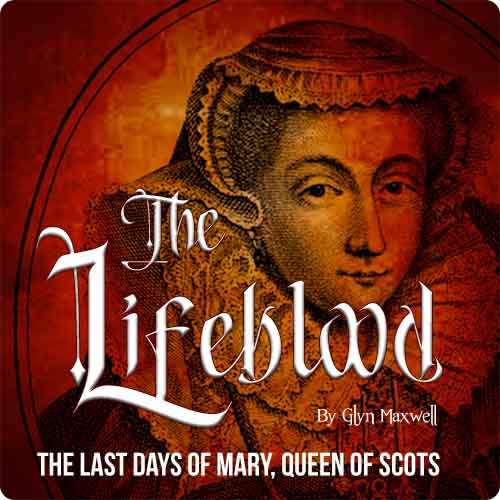
The Last Days of Mary, Queen of Scots
Auditions
Wednesday 12th January: 7.30-10.30pm, Room 1
Thursday 13th January: 7.30-10.30pm, Room 1
Sunday 16th January: 2pm, Room 1
Scripts available from Wendy Bage at [email protected]
I’ll be trimming the play by 20-25%.
Anyone who would like to audition: if you let us know which part or parts you’re interested in, I’ll let you know (in good time) which sections I’d like to hear at audition.
I try to balance gender in a company as much as I can, so apart from Mary – for whom I’ll definitely be casting a female – the other roles can be played by actors of any gender, though all the characters they represent are male. Hope that’s clear!
Mary, Queen of Scots (F, 35-60)
A major role, perhaps the largest I’ve written. Though she’s not in every scene, every scene is about her. Psychologically she is a Queen through and through, but her only realm is a couple of shabby rooms she’s been left to rot in, and her only subject the loyal secretary Arno. In a good mood she is cheerful, lyrical, gallows-humorous, flirtatious – she flirts with just about everyone in the play. In a bad mood she’s withering and cruel. She has a fatal weakness for romantic intrigue. On trial for her life, though physically exhausted and legally defenceless, she astonishes her enemies with her quick wit, humour and grasp of the law. A great spirit, out of which all hope is being gradually crushed.
Claude Arno (M or F, 25-50)
Arno has been Mary’s secretary and confidant for the last 12 years. (He is French, but I’ll only use a French accent if the actor is confident in it. Otherwise the Frenchness will be about style and sensibility.) He is careful, a diplomat. After Mary’s household are sent back to Scotland, Arno is the only company or friend she has left. He loves her, in a private way. He is a wise and cautious counsel, immediately sensing the danger represented by Gorge and Babington, but his voice goes unheard. He cracks under torture and gives the State what they need.
Sir Thomas Gorge (M or F, 30-55)
Gorge is a double-agent, practised enough in the art to convince Mary (if not Arno) of his good intentions. The fact that he is secretly working for Walsingham – who holds all the aces – makes him confident, even intimate, in Mary’s company, and wholly contemptuous of Arno and Paulet. In the company of Walsingham, however, we see him as a nervous sycophant. Gorge’s default is worldly sarcastic wit and he’s good at flattery. His swagger fails in the last act, though, and we see him as a cowardly pawn who’ll do anything to save himself.
Sir Amyas Paulet (M or F, 35+)
Paulet is a Puritan gentleman. His function as Mary’s host has evolved into his being her gaoler. He is implacably opposed to her Catholic religion, appalled by her claims to England’s crown, hostile to her Franco-Scottish origins, and unnerved by her vibrant personality. He is a prim, pedantic jobsworth of the State, increasingly fed up with the role he’s been given. He is only obeying orders, but he’s also desperate to please Queen Elizabeth, whom he idolises from afar. Ultimately he proves himself to have greater moral depth than anyone in the play. Including, for that matter, Elizabeth.
Sir Francis Walsingham (M or F, 40+)
The legendary spy-master of Elizabeth I. That role, the all-knowing, all-seeing and ever-suspecting spider at the heart of the web of State – Stalin’s Beria, or Henry VIII’s Cromwell, or even, at a stretch, Dominic Cummings – pretty much originates with Francis Walsingham. He is a cold, sharp, profoundly brilliant schemer (okay, maybe not Cummings), and justifies all his actions as being in the service of his Queen, the English State, and the Protestant faith. To be this good a spymaster, you need a deep (and deeply cynical) view of humanity. He has this in spades, along with a melancholy wit and a weird sense of honour. Increasingly he sees Mary as a worthy adversary who keeps surprising him, but in the end he holds all the cards.
At Mary’s Trial there are three more Ministers of State (Bromley, Cecil and Hatton), all articulate and hostile, and these would be doubled as follows:
Arno / Bromley
Paulet / Cecil
Gorge / Hatto
Glyn Maxwell
Director
Review: Goodnight Mr Tom

A delightful storyline encompassing rejection, loneliness and the power of love set in socially difficult times, with a range of interesting character parts, this play surely touches the hearts of most audiences.
The set was plain: a division between two rooms, a school hall and the living space in Tom’s very humble cottage, squeezed in carefully. The detail in the cottage was good and atmospheric. The lit headstone, for Tom’s late wife, was beautifully presented but not well placed on stage. Lighting helped the moods created, and the sound, both original music by Peter Dawson and Matthew Scott and recorded incidental selections, very appropriate.
Set in wartime, the 1940s costumes, mostly plain and inexpensive to indicate the economic hardships of the period, were set off by official caps, tin helmets and a varied set of children’s coats and hats. The teacher, Miss Thorne, wore a green dress which was a bit too upmarket and would have set her back at least two years’ clothing coupons!
Tom’s dog, made and operated by Tristan Cameron, was very effective. Although it required an onstage operator, the attitudes and attention it/he created, responding in subtle ways to the onstage action, were very well thought out.
The action is dominated by Tom, a childless recluse. Pete Dawson captured his sadness, his simplicity and his kindliness in a fine leading role. The boy William was played at various performances by twin brothers, Charlie and Harrison Evans. I don’t know which one I saw, but the performance of the 11-year-old conveyed the development of the damaged child, from being fearful and over-cautious, through an awakening to friendship and finally love, with conviction and certainty. Between them they gently revealed their growing, healing love.
A string of secondary characters and extras worked hard to create the various settings and situations as the story developed. Jan Palmer Sayer hinted at the late Margaret Rutherford as the Billeting Officer, and then as Miss Thorne, the teacher who is vital to William’s development, added strength to the scenes. The posh but good-hearted ‘know-all’ Zach was given confident and delightful humour by Freddie Samuels. And Lydia Hopley as Mrs Beech, William’s mother, with only one scene, frightened her son and us with her misplaced religious fervour and hints of cruelty.
Simon Parr, as a collection of local characters (including policeman and vicar), and Keith McDougall (including doctor and ticket collector) made frequent entrances in different costumes. Villagers, an ARP Warden, and nurses and children made busy, momentary entrances to create the bustle of wartime travel, school and neighbours very cleverly. Orla Kennedy soothed her air raid shelter companions with a Vera Lynn song.
The group of children who were William’s playmates had some good moments. They played noisily and ragged each other realistically, and later enjoyed a picnic where although they were certain of their dialogue it was played too slowly and clearly, with no further hint of giggly fun. But mostly, thanks to Director Siobhan Hill Elam, the pace and direction of the play was vigorous enough to keep us interested and, sometimes, moved.
Thank you for an uplifting and interesting production.
Gerry Dale
View from the Back Row
Goodnight Mr Tom

This is a charming and well-loved story dealing with some difficult, topical, yet heart-warming issues which have resonances for the age we live in.
The costumes, set and its detailed dressing evoked the simpler lifestyles of the late 1930s. Excellent lighting design and sound effects set the atmosphere nicely.
Credit must be given to Matthew Scott and Pete Dawson for the lovely music: some written specifically for the play, making good use of cello and guitar, with appropriate orchestral excerpts to heighten the drama (did I detect a bit of Vaughan Williams?).
A strong supporting cast featured two particular highlights: the haunting Vera Lynn moment, sung beautifully by Orla Kennedy during an air raid; and a high-octane cameo performance from Jan Palmer Sayer. Jan has the ability to light up the stage and it made me chuckle to see her as a director of the ‘play within a play’.
There was a core of very able young actors who handled the ensemble playing very well. These children had clearly been directed most effectively and their ‘play fighting’ was expertly choreographed by Tammy Wall.
As the central character, Pete Dawson gave us a moving and sensitive portrayal of Mr Tom. He combined warmth, gruffness and subdued grief plus a very convincing accent and physicality. His relationship with the evacuee, William, was very well depicted as they began to heal life’s wounds together.
Finally, the two young leads. I wasn’t sure whether I’d watched Charlie or Harrison Evans as the repressed William but what superb casting! In complete contrast we had Freddie Samuels as the exuberant Zach: both were conveyed wonderfully by these promising young actors. They sang beautifully too, and their naturalistic portrayals moved us all. Hearty congratulations.
At times the stage felt a little congested. This is a perennial problem with the size of the theatre and it’s very difficult to overcome this. The puppet dog was well handled but, unavoidably took up valuable space. On the night I was there, I was aware of an occasional slowing of pace between scenes but these are minor quibbles.
Overall, this was a delightful evening’s entertainment: a story told with love. My face mask was certainly wet with tears as I left the theatre! My grateful thanks go to Siobhan Hill Elam and her talented cast and creative team.
90 years a theatre
The Barn Theatre is 90 years old!
On 4th January 1932 the Barn opened its doors as a theatre for the first time.
Built around 1598, the Barn was first used as a hay and grain store near today’s Lemsford Road. In 1830 the Barn was moved to its present site combining with another barn to create a large complex on the Lower Handside Farm. With the coming of Welwyn Garden City in 1920, the Barn was converted into a ‘model dairy’ as part of the new Agricultural Guild, with cows in stalls and milking facilities.
This continued until 1926 when the cows moved out due to the enlarging town, and the dairy expanded with modern bottling facilities, butter and ice cream making equipment.
Dr L T M Gray, a director of the Welwyn Garden City Company, converted the empty area where the cows had been into a theatre which opened on 4th January 1932.
The first plays produced were four one-act productions which ran from 4th to 9th January. They were:
- The Invisible Duke by F Sladen-Smith, presented by the Welwyn Folk Players
- The Fur Coat by F J Talbot, presented by the Welwyn Stores Dramatic Society
- The Devil Among the Skins by Ernest Goodwin, presented by the Welwyn Thailians
- The Leading Lady by H J Pointing, presented by the WGC Theatre Society
The first full-length play was The Misalliance by Bernard Shaw which ran from 15th to 20th February 1932 and was presented by then WGC Theatre Society. These first plays were soon followed by regular productions, up to ten a year, and this has continued ever since except during World War 2 and the recent Covid-19 pandemic.
NB:The Welwyn Thalians will be around 93 years old in 2022 – congratulations to them.
The Barn and auditorium 1930


Robert Gill
Friend or faux - REMINDER!

To all the set builders, props warriors and set dressing heroes out there – here’s one for you!
As I mentioned last month, the Barn Council has agreed to fund a workshop in a quick and stunning technique for faux wood and marbling effects for stage sets. It seems to me that we do quite a few shows that need panelling of one sort or another and if there’s a technique we can use to speed this up, as well as looking amazing, then it has to be a good thing. It will give you all yet another tool in your already mighty box of tricks, and help you produce sets that are even better than those you do already.
The image above is not real wood or marble, these are faux effects produced by David Pullin, a local chap who I met at the Living Crafts Fair at Hatfield House about five years ago. I was completely blown away by his work and kept his details. I then, of course, promptly mislaid them but, having found them again recently, I thought I’d try and get a workshop organised for you all.
David has agreed to do a workshop on the afternnon of Sunday 27th February 2022. Possibly after we’ve all met for a drink in our spanking new bar!
We have had some people expressing their interest in attending but we do still have spaces so let me know if you’d like to be added to the list.
Thanks everyone
John Cook
Dates for your diary
Performance
Up Pompeii
by Miles Tredinnick
Directed by Maureen Davies
14th to 22nd January at 8pm
AGM
Thursday 27th January at 7.30pm
Details to follow
Auditions
The Lifeblood
Written and directed by Glyn Maxwell
Wednesday 12th January at 8pm, Room 1
Thursday 13th January at 8pm, Room
Sunday 16th January at 2pm, Room 1
Performance
A Bunch of Amateurs
by Ian Hislop and Nick Newman
Directed by Bob Thomson
4th to 12th February at 8pm
Auditions
Kiss Me Quickstep
by Amanda Whittington
Directed by Jon Brown
Tuesday 8th February at 8pm
Thursday 10th February at 8pm
Sunday 13th February at 10.30am
Performance
Sydney and the Old Girl
by Eugene O’Hare
Directed by Belinda Gee
16th to 19th February at 8pm
In the Studio
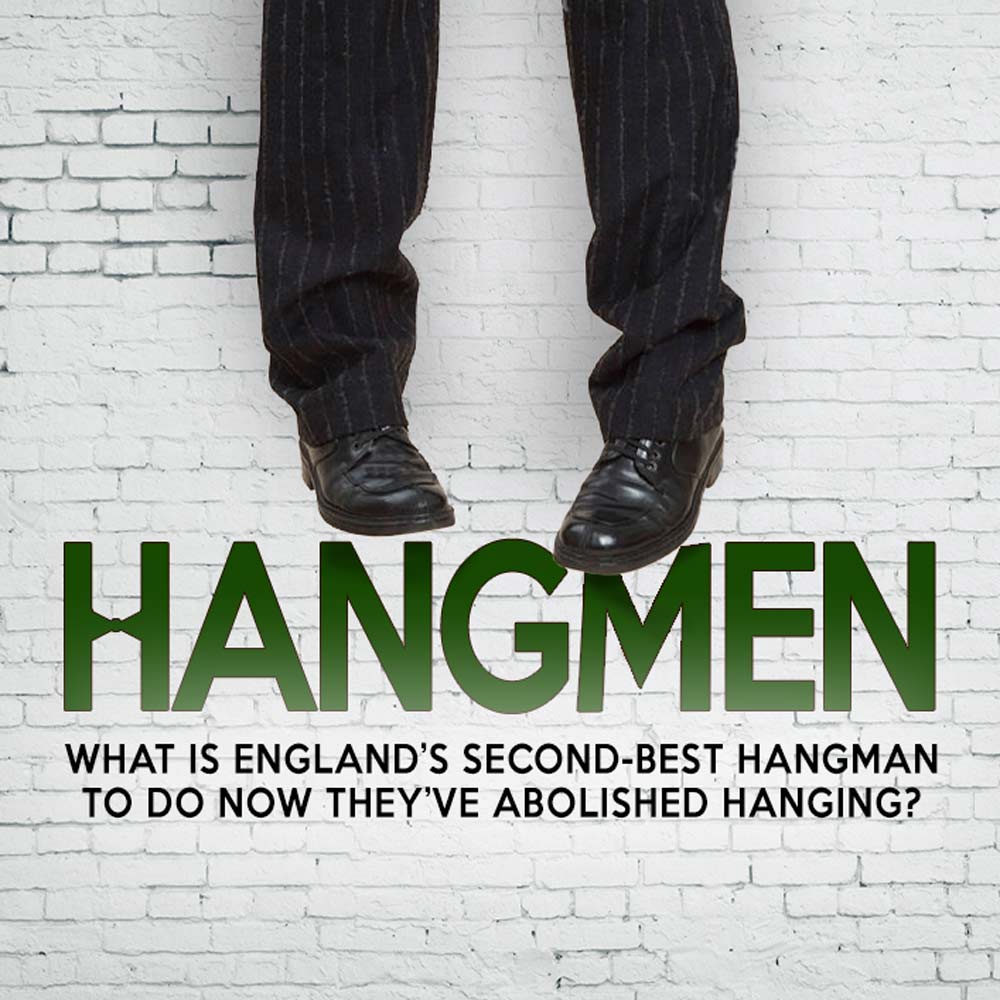
Cast Announcement: Hangmen
By Martin McDonagh
Directed by John Cook
I can’t tell you how delighted and thankful I was following our auditions. We had over 25 people take the time to prepare and turn up, quite a number of non-members too which is brilliant – a huge amount of talent.
I’d like to say thank you to each and every one of you.
John
CAST
Hennessy Tallan Cameron
Guards Cliff Francis, Rob Wallace
Governor Peter Dawson
Doctor TBC
Harry Roly Taylor
Syd Paul Russell
Alice Emily Fairman
Bill Barry Grossman
Charlie TBC
Arthur John Keogh
Clegg Steve Hartill
Inspector Fry Ian Colpitts
Mooney Michael Curry
Shirley Alice Croot
Pierrepoint Peter Dawson
TBC
CREATIVE TEAM
Production Manager Carol Bush
Stage Manager Michael Merry
Deputy Stage Manager Sharon Francis
Assistant Stage Manager Cliff Francis
Set Dressing Kris Moore, Peter Moore, Christine Cowley, Sue Walters
Wardrobe Yvonne Bartlett
Sound Rob Wallace
Lighting Design Trevor Wallace
Lighting John Cude
Properties Sheila Grimmant, Christine Cowley
Rehearsal Prompt Anne Woolmington
Production Photography Simon Wallace, John Davies
Poster Design John Cook