
Beginning
Don’t miss this brave, beautiful, intimate two-hander
The Barn’s been buzzing, with Hansard coming to a triumphant finale, gales of laughter as Beginning rehearsals near the end, and rehearsals for The Massive Tragedy of Madame Bovary begin. And there’s no mistaking what’s been going on in Room 1, as glorious young renditions of Consider Yourself burst forth.
Paul Morton directs Beginning, our second two-hander of the season, opening on Friday 22nd March. We’re getting used to seeing a two-hander, with no interval, on the main stage, and I have to say I like them, even though I miss out on the interval ice cream!
Beginning, by prolific British playwright David Eldridge (a less well-known writer than he deserves to be) collected five stars and sold out when, directed by Polly Findlay, it premiered at the National’s Dorfman Theatre in 2017. It transferred to the West End at the end of its run and the ‘brave, beautiful, intimate two-hander’ was immediately singled out by critics as a classic of British theatre.

‘Eldridge combines a hugely sympathetic sensibility with rare dramatic power, and one leaves this exceptional play rejoicing in his talent and impatient for his next.’ Telegraph
Beginning is the first of a trilogy. The second, Middle, premiered at the National in 2022, and the third, End, is expected this year.
It captures a moment when two lonely people, Laura and Danny, who live in the age of internet dating, find themselves having to deal with a moment of awkward attraction in the ‘old-fashioned way’. It’s the early hours of the morning and she’s surveying the remains of her house-warming party at her north London flat, while Danny, the uncomfortable last guest, is not sure if he wants to stay or go. They have to find the courage to kiss and admit they like each other, without the crutch of social media.
Director Paul Morton has an impressive directing and back catalogue with Hertford’s Company of Players – and earlier! He got the acting bug when he started to perform in boy scout gang shows, aged 9! He joined CoPs about 20 years ago and since then has acted and directed in numerous productions. This is his first Barn production. He said:
‘Beginning was the play I’d wanted to direct for some time, so I didn’t hesitate when Clive Weatherley, the Barn’s Artistic Director, asked me to direct something in this season. I’ve got two terrific Barn actors, neither of whom I’d known before and, with such a small cast, we have the luxury of really thinking about their inner worlds and back stories, which all helps to fully realise the characters of these two lonely people’.
In welcome returns to the Barn stage, Pete Bryans (last seen in The Crucible) plays Danny, a 42-year-old middle-management guy, who’s called a bit of a Tory Boy by his nan and lives with his mum. Laura, played by Jessica Drucker, who made her Barn debut two years ago in Alys Always, is a 38-year-old managing director. Not much in common then except, perhaps, loneliness.
You’d be forgiven for thinking this may be a rather sad play, but author Eldridge said:
‘The audiences have enjoyed themselves more than I thought they would – they’ve laughed more and cried more’.
They’re doing a lot of that in rehearsals too!
Carol Bush
From the Chair
Welcome to March’s Barn News

Hansard was the Barn at its best: a terrific play, wonderful acting, an amazing set and great direction. In fact, a neighbour stopped me in the pouring rain to say how much she loved it.
John Cook’s time lapse video showed all the effort by a large team of people to build, paint and dress the set, and then we pulled it down in less than two hours! Such is the life of the theatre, and so we move forward to the next show.
March is going to be a busy month, starting with three very different performances in the bar area on consecutive evenings. Daniel Ephgrave’s musical evening, followed by Creation Theatre’s production of Glyn Maxwell’s new play Boatman Town, and then Singers at the Barn. We really are lucky to have such a range of shows for members and the general public, but I’m conscious of the hard work this means for technical support and housekeeping. So, my heartfelt thanks go to Tristan Cameron, James Rowles, Clifton Hoyle, Nick Mogg and Sharon Francis.
We then welcome 14 teams of young actors, three of which are from the Barn Youth Groups, when we host the 80th Welwyn Garden City Youth Drama Festival in the first week of March.
I’m looking forward to seeing them compete for the trophies, and I hope many of you will also come to support them.
Our next main auditorium show is Beginning by Jim Eldridge starting on 22nd March, starring Jessica Drucker and Pete Bryans, both of whom are well known to Barn audiences.
Finally, I’m pleased to see that our membership is growing, thanks in no small part to Nigel Rive’s efforts, but also boosted by our recent open morning and the cast of Oliver!
I hope that some of these young members enjoy their experience at the Barn and want to come back in the future to participate in the life of our theatre. As an aside, the proportion of senior members is now at its lowest level for quite a while.
I think there’s something for everyone to enjoy this month, so I hope to see you at the Barn.

Ian Major
Chair
Reviews
At the AGM I apologised for the review of Grimm Tales having gone astray. Now that it’s been recovered it’s published in this issue with, once again, my apologies to the cast, crew and director. I also appealed for members willing to write reviews ‘From the Back Row’ to volunteer, and I’m pleased to say that as a result we’re now able to cover the remainder of the main house productions this season. Council has approved the continuation of the reviews in Barn News but they will no longer be optionally anonymous.
Keith Thompson
Review:
Grimm Tales
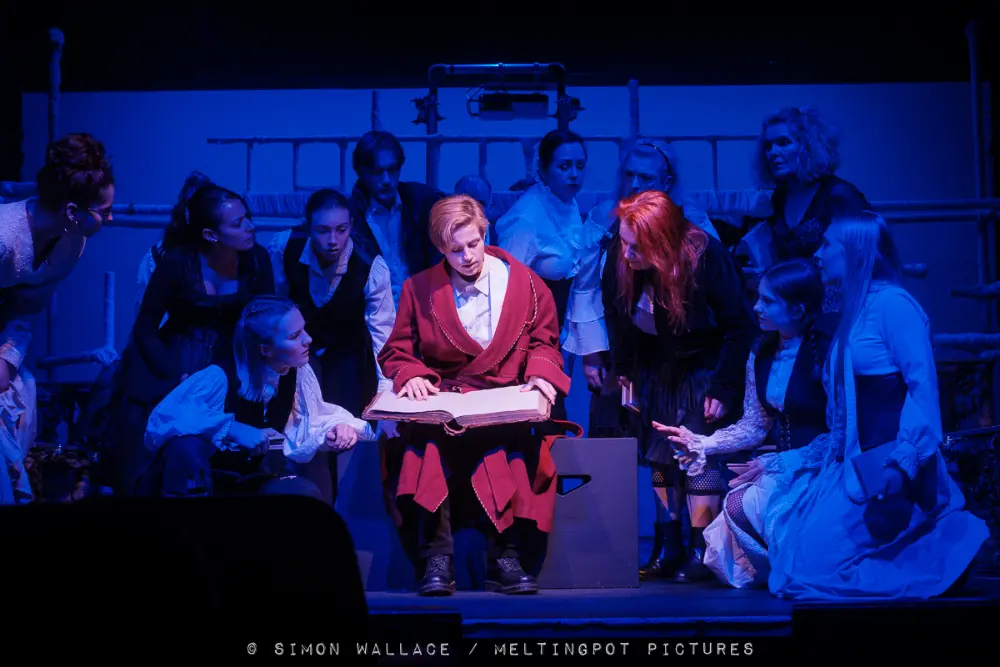
In this production the company brought us a selection of the famous folk tales collected by the brothers Grimm. Stories full of magic, wicked witches, cruel stepmothers and happy endings abounded, sometimes accompanied by grisly punishments for the evil antagonist.
The tales were acted out with the various cast members stepping forward to narrate or take different roles in the different tales, and this was done with a great sense of fun.
The text they were working from was prepared direct from the original tales by Philip Pullman and Philip Wilson. Interestingly, in his introduction in the programme, the director, Simon Wallace, notes that the script actually gives little beyond the story itself. There are no stage directions or indications as to how it should be dramatised. The director and cast have, therefore, a great deal of freedom in how they present and frame the tales. Some good and imaginative ideas were apparent in how they went about this, however not everything was successful, and there were, in places, awkward discontinuities between the text and the extra bits of business introduced.
There were, nevertheless, some lovely ideas which worked beautifully. I don’t know if I was the only person in the audience who really enjoyed the fact that the dances in the ballroom scenes in Thousandfurs were done to a stately version of I Wanna Dance with Somebody, but it tickled me every time. Another good joke well done was the Huntsman in the same story collecting the firs for the coat by wringing the necks of cuddly toys. The use of characterful puppets for The Three Little Men in the Woods was also very effective.
The reviewer notes that the cast is listed in the programme, however no individual roles taken by each member of the cast is given. Identifying individual cast members by name is therefore impossible for me, and wouldn’t feel appropriate even if I could do it – this is a team effort. The cast had many young actors in it, who came to the Barn along with the production, which (I gather) had originally been done in a school and they were joined by other Barn performers. It’s fantastic to promote young actors and these showed us their talent and carried us along with their infectious enthusiasm. The gender balance was distinctly one-sided, however – where are the young men?
A few years ago, I attended a performance at the Barn (not as a reviewer) of The Arabian Nights by Mary Zimmerman, based on the story of Scheherazade with a selection of her 1,001 tales dramatised in a very similar way – all members of the cast were onstage all the time with different members coming forward to present or enact the individual stories. This production was, I felt, a triumph and a contrast with these Grimm Tales may be enlightening. A large part of the problem is with the text itself. In the Grimm Tales script, no work is done (apart from a brief introduction) to frame the stories or make them work together as a drama. The stories are fine in their own right, but they do not have the variety or depth that the tales of The Arabian Nights have, nor do they have that helpful tale-within-a-tale structure. The construction of the Arabian Nights script is, in contrast, very finely crafted and it had very effective live music on the stage, where Grimm had a backing track which some cast members sang over (OK, but a bit cheap in comparison). The end result is that the Arabian Nights could cohere into a magical evening in the theatre, but Grimm Tales is fighting an uphill battle to do any more than tell some familiar fairy stories. A lot of effort was made to add business and jokes, but this could interrupt the flow and sometimes fell flat.
The first story we were given was Hansel and Gretel. There were some particular problems with the pacing here, so it didn’t get us off to a flying start. It may not have helped that we obviously had a stand-in playing the wicked stepmother, who came on with the script, however I suspect not – there were silences, for example where the children who were making their way through the forest left the stage and then came back on, where nothing else was happening. Things improved as the evening went on; we got slicker transitions, better jokes and more characterful lead characters. Particular credit here to the wolf in Red Riding Hood, the witch in Rapunzel and Thousandfurs.
Where the tales were told with pace, and where the business was slick and appropriate, the production was great fun and a pleasure to witness. The couple in the seats next to me had a lovely time and enjoyed the evening tremendously as, I’m sure, did the cast. I hope these young people will be inspired to continue acting and to gain experience with more challenging roles.
Oliver Hitch
View from the Back Row
War and Peace
At the end of the first Saturday evening performance of War and Peace the audience quickly rose to their feet to give a standing ovation. A rare occurrence in my Barn experience, and entirely deserved. At the time of writing (the Thursday before the last performance) it’s not happened again: I suspect that the two halves of the play being performed on separate evenings took away some of its magic.
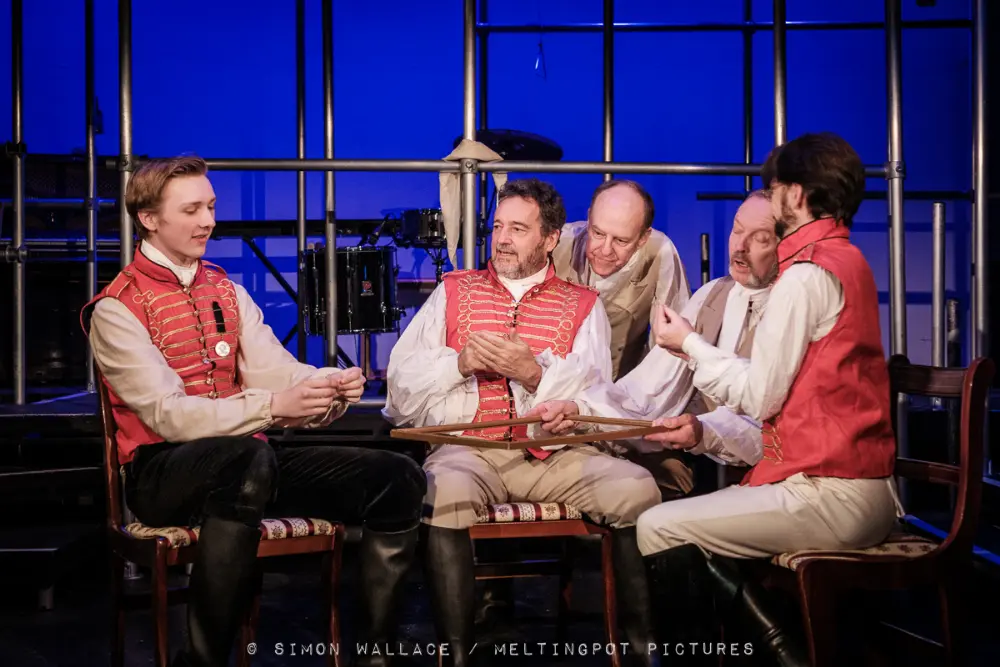
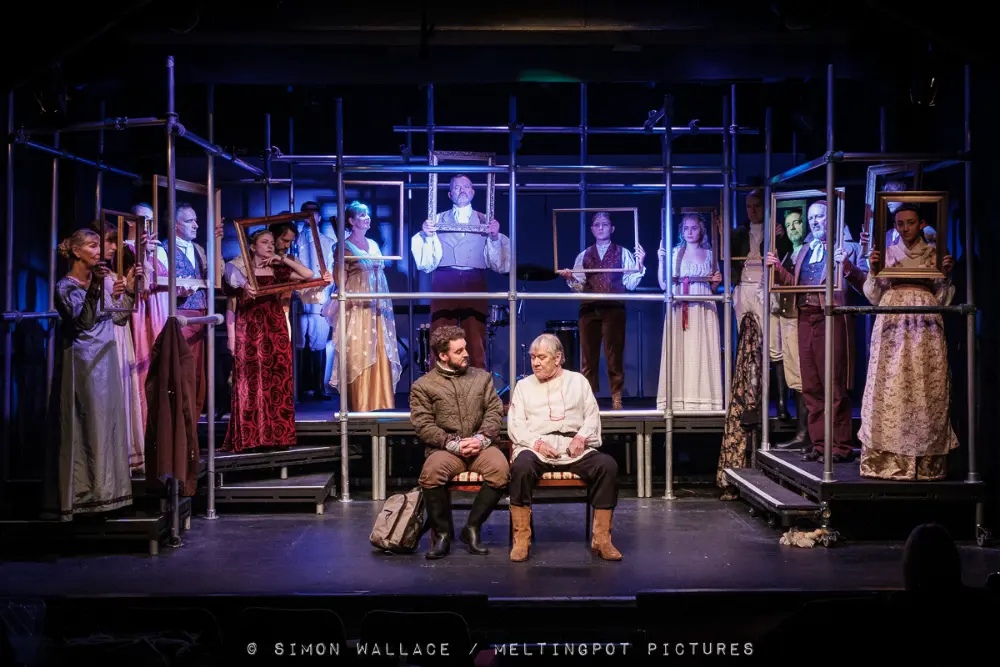
What made the performance so special? I can only give my own opinion, which is that the standard of every aspect of it was first class; but above all it was Steve Thompson’s direction. Most of the cast of 20 were all on stage for a considerable part of the play, and their entrances and exits were invariably slick and unobtrusive. That is a major directorial achievement in its own right, but the high standard of every other technical aspect of the production, while dependent of course on the skills of those directly involved, also owes much to the director’s guidance. And Steve’s ability to recruit the Barn’s best actors and technical members was also a factor in the success.
The lighting design by Clifton Hoyle was superb, and immensely complex. I gather there were 380 lighting cues, possibly a Barn record, and if there was any mistake I was unaware of it – congratulations to the operators. The music, directed by Rob Wallace, was equally impressive, much of it performed by some of the actors: it added greatly to the excitement and emotion of the play itself.
I’d assumed that the costumes had all been hired, but from an after-show conversation I was amazed to learn that Tiffany Breeze, Jenny O’Sullivan and Yvonne Bartlett had designed, made or acquired nearly all of them, including Napoleon’s. I’ve only the vaguest knowledge of 19th-century Russian clothing, but I thought they all looked fantastic.
Some of the Barn’s most talented actors had quite minor parts in this production, another tribute to Steve’s ability to recruit the best. I won’t give a separate mention to all the cast, but it was good to see the return of Des Turner, who gave a convincing portrayal of the tyrannical Prince Bolkonsky, and of Lou Wallace as his relatively innocent seductress Mademoiselle Bourienne. Alice Croot was excellent as his much-bullied daughter Maria, and her eventual conquest by Nikolai was quietly moving. Julia Riley as Countess Roskov was also moving in her subtly underplayed recital of her son’s life, and Natalie Gordon made the most of the comic but relatively minor role of Anna Povlona.
Turning now to the larger roles, Gavin Palmer gave a suitably restrained portrait of the heroic Andrei, and Christopher Wallace made the most of the vital role of Napoleon. Hattie Thompson was entirely believable as Pierre’s serially unfaithful wife Hélène. Sean Scotchford got Pierre absolutely right: initially a rueful rake, a rather innocent admirer of Napoleon, and an equally innocent supporter of Freemasonry, he became convincingly wiser and more questioning with age.
The role of Natasha is not an easy one. She’s only 13 at the beginning (though the playwright wisely keeps that fact from the audience) and is a mature mother at the end. She betrays her fiancé with a foolish affair with a worthless married seducer, but has to retain the sympathy of the audience until eventually marrying the widowed Pierre. Kizzie Hopkinson met all these challenges with great skill: I’ve seen her give excellent performances in other Barn production, and I thought this was her very best.
So what of the play? I must confess here that I’m not the best judge of that because, knowing I was to be writing this review, I not only read the script in advance, but also re-read a fair chunk of the Tolstoy novel on which it’s based. So my opinions on the clarity of the story, and on the nature of the characters in it, are likely to have been more favourable had I not taken those steps. On the other hand I saw and heard the audience’s enthusiasm at the end, so am pretty confident that others had the same positive reaction to it that I did.
The final question I feel bound to ask is whether the performance schedule, with only one chance to see the play on the same day, was the right choice. It was a difficult choice, and I understand why it was made, but if we ever do another four-hour play I believe it would be better to start at 7pm and have one interval, finishing at 11.
John Davies
A wise older man full of wit and charm
Review:
Hansard

Hansard by Simon Woods is a two-hander in one act which takes place on a May morning in 1988 in the kitchen of our dramatis personae – a Thatcherite Tory MP and his distinctly left-leaning wife, Robin and Diana Hesketh. The couple clash not just on politics but seemingly on everything, and the drama gradually illuminates some of the history of their relationship and the roots of their conflict.
We start to see what brought them together and how deep-rooted their commitment to each other might really be. We also learn of the tragedy which has torn them apart which they appear to have never discussed.
A two-hander will ideally need not just two strong actors but two actors who gel together to make it work. In this production we got that – Emily Fairman and Paul Brown were both absolutely terrific. They are, obviously, very experienced and have performed frequently at the Barn and elsewhere. One might imagine that the fact that they first acted together when they were at school in 1985 may have helped them to bond in the roles of this long-standing and fractious couple, but that may be too fanciful. What I can say is that they worked brilliantly together. Their dialogue had every tiny step in mood between gentle joshing and shouting accusation all of which were navigated with subtlety and precision. This was, in part, achieved with very careful pacing – everything from fast, snappy patter to quiet asides and drawn-out confessions. After it appeared that Diana had actually forgotten that it was Robin’s birthday, they reached a point where there was nothing more they could say. They held an amazingly long tense pause which kept us on the edge of our seats throughout – it was as though there was so much not being said that the silence was hard to bear.
It would be easy to overlook what a good job was done by Hannah Sayer as director, as her choices here were subtle. The director’s role must, of course, partly be to enable the actors to inhabit the characters and to reveal them to the audience. The staging removed barriers to this process – it was focused on realism and believability; the couple spent the play circling around their entirely believable kitchen in a believable way, and it was easy to feel it was their home.
To this end, the set included masses of detail to give us a completely convincing and realistic well-to-do country house kitchen from the 1980s. The brickwork, the gilded plates on the rack over the sink, the random diagonal black pipe coming up from behind the cooker, all these details painted the picture perfectly. There were a large number of people involved in this – 15 individuals in the programme – doing set design, construction, dressing and painting. Congratulations to all of them: your efforts were rewarded. The lighting by Tristan Cameron was static, but nevertheless very well done to evenly light the set and make it feel like a bight summer morning.
There was lots of good preparation work evident here, not least in the practical business of making coffees and Bloody Marys, collecting empty gin bottles and many other actions with props while simultaneously delivering the dialogue. It looks simple but it takes organisation and practice. More important is the work obviously done in understanding the characters, their motivations, their history and their innermost feelings and drawing that into a performance that is meaningful to the audience.
The politics of the day was obviously Thatcherism and the arguments on both sides felt very familiar. We all went through those arguments back then, though some of us just had to shout at the radio as we didn’t have a Tory MP on hand. To my ears the anti-Thatcher case came across as the more convincing; the pro-Thatcher case felt reactionary, elitist and old-fashioned. This is probably just personal perception, though it may also be a reflection of Simon Woods’ own attitude. It presents a challenge though, in that it’s hard to see how these two, with such opposing outlooks, could ever have chosen to make a life together.
When finally, at the end, they do manage to tell each other the thoughts and secrets that have been keeping them at loggerheads all this time, and reach a tentative, poignant reconciliation, the relief is huge. You realise that perhaps the conflict and the arguments were to distract from hidden guilt and sorrow, and that maybe they are not so different from each other after all.
Oliver Hitch
Letter to the Editor
I have just come home from seeing a brilliant performance of Hansard. The play is so well written and the two actors were outstanding. I saw War and Peace recently, gave it a standing ovation and thought it was the best thing I’d ever seen at the Barn. Hansard has superseded even that. Once again I stood up at the end to applaud because this was some of the finest acting and direction I have ever seen. Well done and thank you to all involved.
Please pass on my congratulations to everyone involved (including the War and Peace company).
Vivienne Lafferty
Publicity and Marketing Officer National Drama
Madame Bovary
Cast and crew

All characters played by the ensemble:
Josie Melton, Gavin Palmer, Danny Swanson
Lorna Thompson
Musicians: George Curry, Rob Wallace
Stage Manager – Nigel Rive
Assistant Stage Manager – Victoria Rive
Production Support – Simon Wallace, Jane Pennett
Props – Sheila Grimmant, Georgie Palmer
Costume – Al Farrell, Lou Wallace
Sound – Rob Wallace
Lighting – Clifton Hoyle, Trevor Wallace
Production Manager – Carol Bush
North Herts College: theatre for future generations
On 6th February we had the pleasure of visiting the Hitchin campus of North Herts College (NHC) to see five teams of students present their ideas about how the Barn could enhance future Open Days, together with suggestions for extending the reach of marketing, with an emphasis on attracting younger and more diverse audiences. We were made very welcome, and it’s a great campus.
We’d been approached by the college last September asking if we’d help Performing Arts students with a project that would be part of their coursework, and we were delighted to assist them. The students had a tour of the Barn and a chat with some of the members, and some also came to the Open Morning in December to help shape their ideas.
It was great to see the students’ enthusiasm when they were giving their presentations, and they clearly were impressed with the Barn and the passion of all the volunteers who help out. We had a lively question and answer session, and they made a few telling points about how the Barn and theatre in general can appear aloof, and too elitist for many people. They went on to make suggestions about how these perceptions might be changed in order to make local theatre more inclusive for everyone in the community.
We’ll definitely be adding their ideas to the list of things to be considered and will look to find many more ways to collaborate on projects with NHC and other local colleges in the future. These partnerships are mutually beneficial, for example NHC has a thriving costume design section and they appeared very keen to get involved with future production designs.
Danny Swanson and Ian Major
Who's Who at the Barn
Directors
Chair Ian Major [email protected]
Finance Sofia Oliva (07493 854400) [email protected]
Marketing Barbara Holgate-Stuckey (07740 812950) [email protected]
Membership Nigel Rive (07768 867534) [email protected]
Facilities Michael Merry (07973 238346) [email protected]
Stage Director Robert Gill (01707 324572) [email protected]
Props Director Sheila Grimmant (07970 929290) [email protected]
Show costumes Anne Mawer (07968 829084) [email protected]
Non-Executive Sarah Gennoe (07990 595245) [email protected]
Non-Executive Danny Swanson (07583 613696) [email protected]
Administration John Davies (01707 882209) [email protected]
Youth Group Jacqueline Clayton (07981 866568) [email protected]
Ex-Officio Council Members
President Vacant
Company Secretary Linda Miles (01707 335718) [email protected]
Non-voting Council Members
Artistic Director Clive Weatherley (07773 044801) [email protected]
Social Hannah Humbles (07940 226917) [email protected]
Other responsibilities
Archives Rob Wallace and Alice Croot
Barn News Mike Smith (07774 849606) [email protected]
Bar Manager Martin Moore (07768 650660) [email protected]
Child Protection Linda Miles (01707 335718) [email protected]
Club Nights Hannah Humbles (07940 226917) [email protected]
Coffee Bar Sue George (01707 330274) [email protected]
Costume Hire Sheelagh Mogg (07909 196252) [email protected]
Direct Debit Admin Ian Major (07789 728997)
FoH Admin Wendy Bage (07834 586144) [email protected]
Library Clive Weatherley (07773 044801) [email protected]
LTG Rep John Cook (07973 221617)
Photography Simon Wallace (07875 423550) [email protected]
Photo-studio Hire John Davies (01707 882209) [email protected]
Private Hire Victoria Rive (01707 336446) [email protected]
PR (temporary) Carol Bush and Georgie Palmer [email protected]
Rehearsal Rooms Victoria Rive (01707 336446) [email protected]
Singers at the Barn Michelle Williams (07946 376993) [email protected]
Site Manager Sharon Francis (07885 421051) [email protected]
Stage Lighting Nick Mogg (07802 866843) [email protected]
Stage Sound James Rowles (07958 427927) [email protected]
Studio Director Cliff Francis (07547 373326) [email protected]
Website John Cook (07973 221617) [email protected]
Workshop Roger Eames (07734 051029) [email protected]
Youth Groups
Barn Erroll Louise Parr (07875 436317)
Barn Pigwidgeon Georgina Bennett (07923 620163)
Barn Hedwig Georgina Bennett (07923 620163)
Barn Hermes Sean Scotchford (07814 236260)
Green Room / Bar 01707 330672
Theatre Box Office 01707 324300
Dates for your diary
Performances
Sonorité Music Concert
The Sound of Magic
1st March 8pm
In the Clubroom
Boatman Town
By Glyn Maxwell
2nd March 8pm
In the Clubroom
WGC Youth Drama Festival
4th to 8th March 7.30pm
9th March 6pm
Beginning
By David Eldridge
Directed by Paul Morton, assisted by Calypso Powell
22nd to 30th March 8pm
Matinee 30th March 2.30pm
Oliver!
By Lionel Bart
Directed by Hannah Humbles and Amanda Sayers
18th to 27th April 7.30pm
Matinees 20th and 27th April 2.30pm
Auditions
Harvey
By Mary Chase
Directed by Belinda Gee
Sunday 3rd March 3.30pm, Studio
Cabin Pressure
By John Finnemore
Directed by Sharon Francis
Friday 1st March 7.30pm, Studio
Sunday 3rd March 10am, Room 1
Social events
Singers at the Barn
Sunday 3rd March 7.30pm for 8pm
Jazz Night
Friday 5th April 8pm
Comedy Night
Saturday 6th April 7.30pm for 8pm
Directors Evening
Sunday 12th May 8pm
Next Council meeting
Tuesday 12th March 8pm
Bar reminder
Barn bar opening hours
Fridays: 8pm to 11pm
Members’ password
APPLE